User Experience of Claude Opus 4.7
The experience of using Claude Opus 4.7 is a classic case of “one man’s meat is another man’s poison.” It is not a simple, comprehensive upgrade, but rather a targeted and costly reconstruction of capabilities. To answer the question of “how is the experience,” we must break it down, as different types of users receive vastly different answers.

For enterprise users, it is a hardcore productivity tool for “cost reduction and efficiency enhancement.”
If your company or team has a core need to handle complex, long-cycle professional tasks, the experience improvement with Opus 4.7 is significant. Its optimization directly addresses the core pain points of enterprise-level applications.
- In complex programming, it shows greater autonomy and reliability. According to early customer feedback, in 93 programming benchmark tasks on GitHub, its performance is 13% higher than Opus 4.6 and it solved 4 tasks that previous models could not complete.
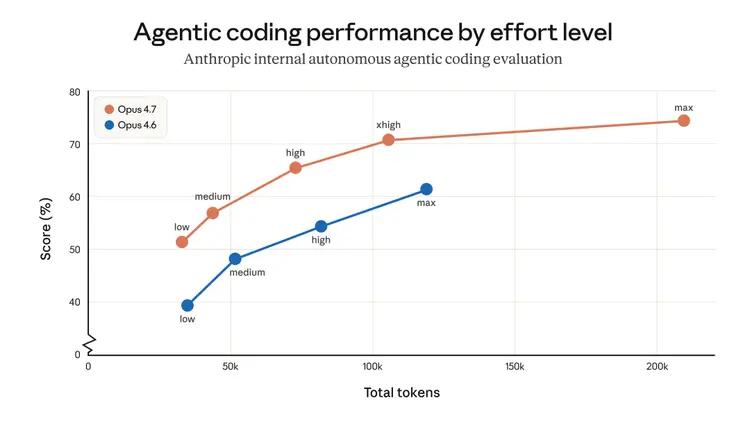
The technical vice president of financial software company Intuit pointed out that the model can autonomously identify logical errors during the planning phase, reducing the bug rate by 40%. This means developers can more confidently delegate hardcore coding tasks that previously required close supervision, directly enhancing development efficiency.
- In visual and professional analytical tasks, the capability leap is even more dramatic. Its visual acuity benchmark score soared from 54.5% in Opus 4.6 to 98.5%, with a maximum supported image long edge of 2576 pixels, more than three times that of previous versions. This makes it possible to handle high-resolution screenshots and complex chart data extraction tasks.
In internal evaluations by financial analysts, its instruction adherence accuracy reached 97.2%, enabling the production of more rigorous analytical models and professional presentations.
Therefore, for benchmark clients like GitHub and Notion (with a 14% accuracy improvement), the experience is positive. The model acts more like a “truly capable colleague,” reducing meaningless scaffold code, proactively validating outputs, and remembering key notes in multi-turn long conversations without needing to repeat context when advancing new tasks.
However, in the developer community, the experience is filled with controversy and division.
Some developers who recognize its hardcore capabilities are using it to advance actual projects. However, more voices from the community point to frustrating regressions.
- Code capabilities have shown “mystical” fluctuations. Despite impressive official benchmark results, many developers report that programming tasks that were reliably completed with Opus 4.6 are now frequently failing. A Reddit user conducted regression tests on known answers with long refactoring tasks and found that Opus 4.7 “confidently failed 3 tests that should have passed.”
Gergely Orosz, author of “Pragmatic Engineer,” even described the new model as “surprisingly aggressive,” ultimately choosing to revert to version 4.6.
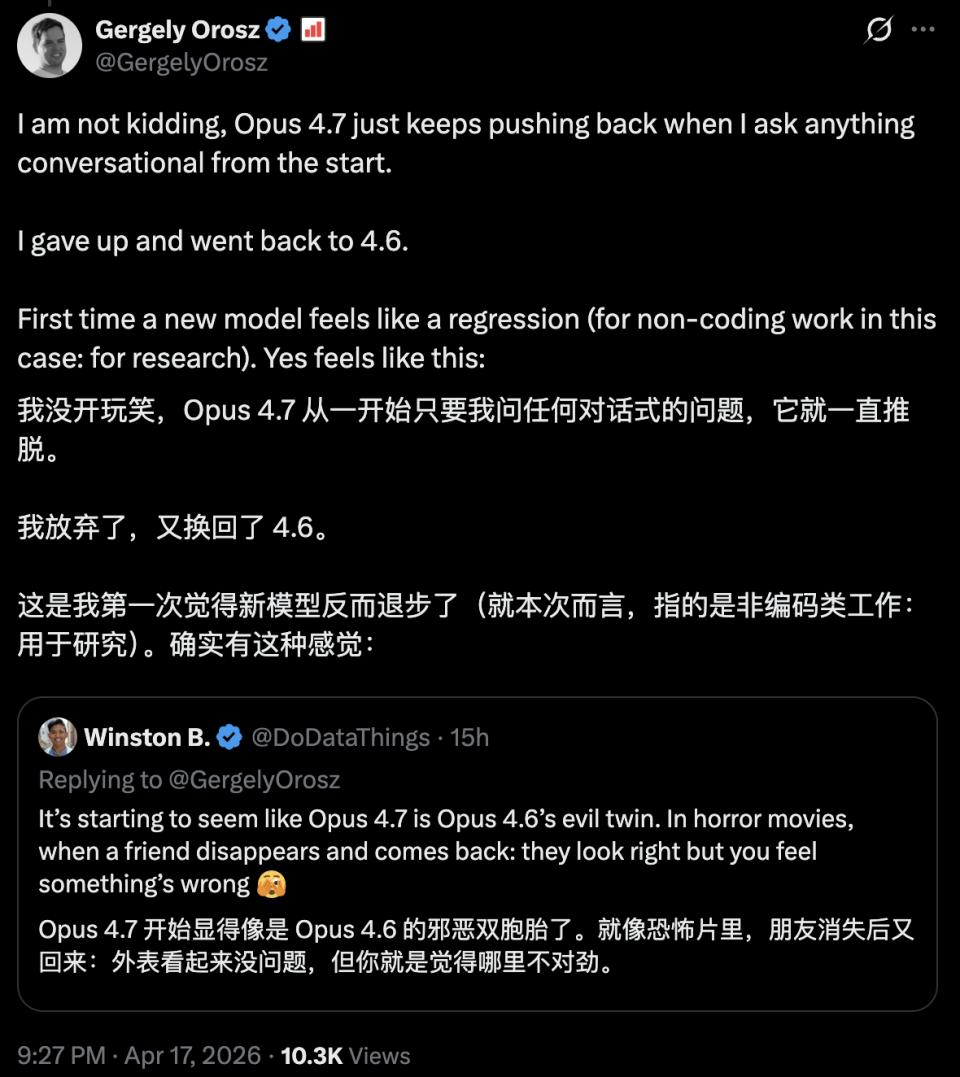
- Long context retrieval capabilities have severely “flopped.” This is the most criticized aspect. Official data shows that its long context retrieval accuracy plummeted from 78.3% in Opus 4.6 to 32.2%. Users report that even when information is clearly present in the context, the model often misses it. This poses substantial difficulties for developers in the legal and financial industries who rely on long document processing.
For ordinary users and content creators, the experience may be a “disastrous” regression.
If you primarily use Claude for dialogue, creation, or editing copy, the experience gap when upgrading to 4.7 will be significant.
- “Writing quality” has degraded, filled with jargon. Users generally complain that its writing style has become stiff, filled with workplace clichés like “steadily catching” and “solidifying the loop,” resulting in dry continuation content. One user remarked, “It used to take me less time to revise its copy; now it takes me twice as long to revise its output.”
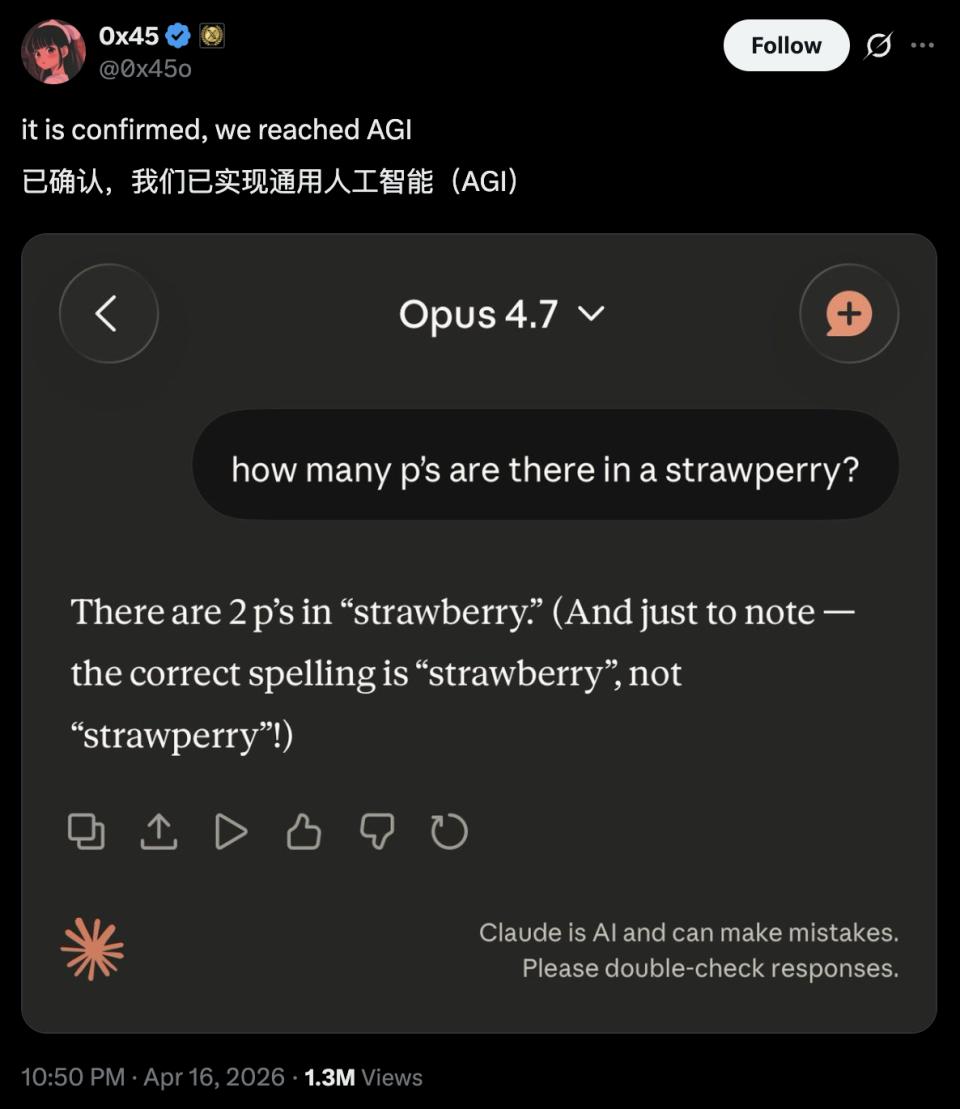
- The hidden cost of usage has significantly increased. Although API pricing remains unchanged, due to the new tokenizer, the token consumption for the same input is about 1.0-1.35 times that of the old version, equating to an actual cost increase of 10%-35%. In visual scenarios, some users tested the input tokens for the same design draft, which turned out to be more than 3 times that of the old version.
For daily use that does not yield high-value output, the cost-effectiveness is extremely low.
Overall Judgment: A Precise “Commercial Screening” Rather Than a Universal Upgrade
In summary, the experience of Claude Opus 4.7 is essentially a clear commercial positioning by Anthropic.
It sacrificed some of the “humanity” of general dialogue and the stability of long context retrieval, sharply tilting its massive computational power and optimization focus towards high-value, high-difficulty professional production scenarios (complex programming, high-resolution visual analysis, rigorous financial and legal workflows). Simultaneously, by covertly increasing token consumption, it objectively filtered for users with stronger willingness to pay, such as enterprises and high-net-worth professionals.
Thus, your experience entirely depends on your identity and scenario:
- If you are an enterprise user handling complex programming, visual analysis, or professional analysis, it can bring significant efficiency improvements, making it worth upgrading, but you must accept the reality of increased costs and the need to adapt prompts from the old version.
- If you are a developer or professional relying on long document reasoning, the current version may pose serious risks, and it is advisable to proceed with caution.
- If you are primarily an ordinary user or content creator, this upgrade is likely to be “more expensive and less usable,” making it wiser to stick with Opus 4.6.
It is no longer the universal assistant trying to please everyone, but is evolving into a “heavy artillery” aimed at the professional battlefield.
Comments
Discussion is powered by Giscus (GitHub Discussions). Add
repo,repoID,category, andcategoryIDunder[params.comments.giscus]inhugo.tomlusing the values from the Giscus setup tool.