Vibe Coding: Transforming Developer Roles and Boosting Efficiency
In 2026, a non-gaming experience designer validated a game control scheme in half a day. Previously, he would have waited nearly a month for the development team to schedule, code, and debug. Now, he described a strategy game idea to an AI, and after a few dialogues, a playable demo was created.
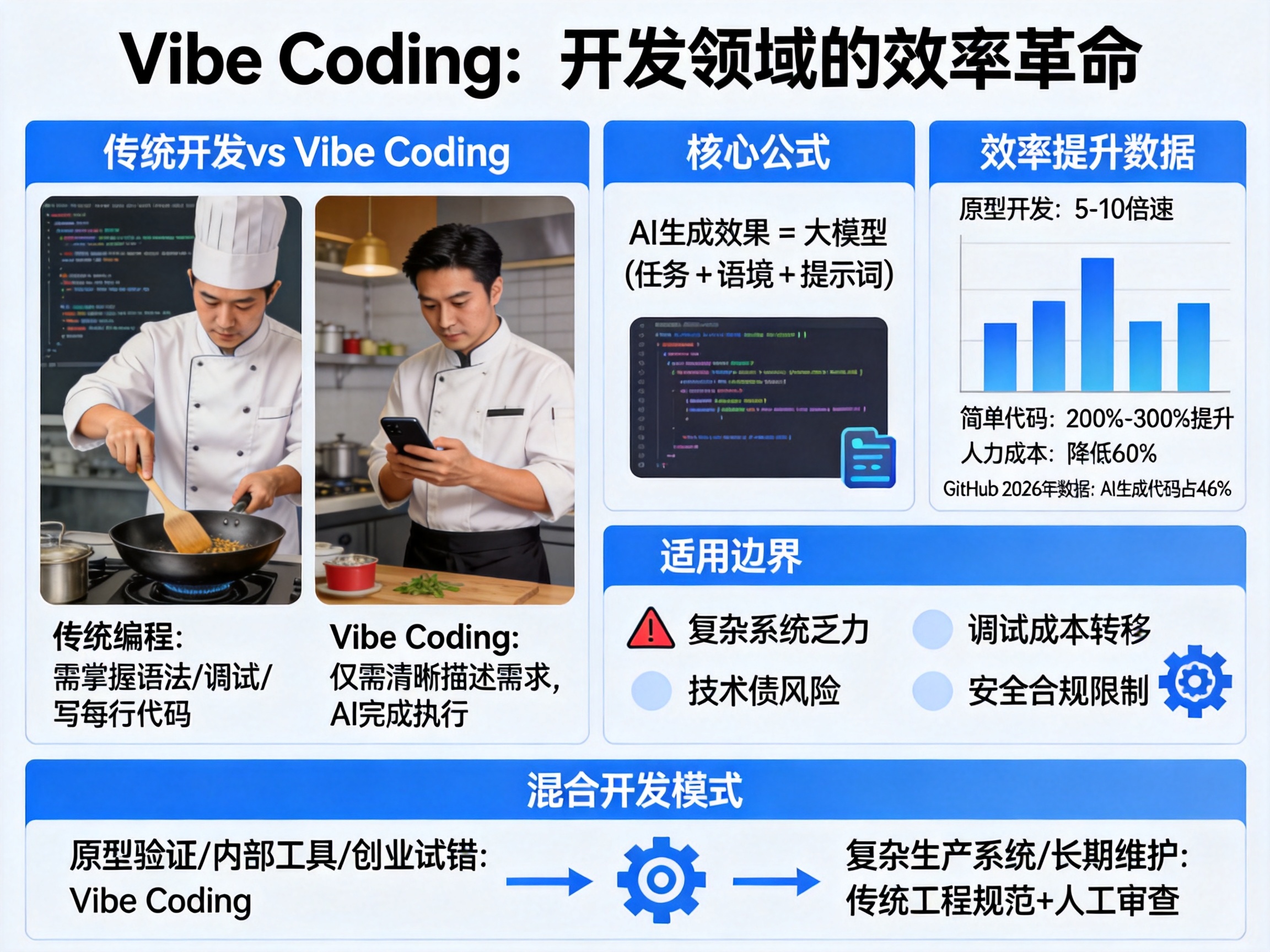
This case exemplifies the emerging trend in development known as Vibe Coding. The key to its efficiency is not merely that “AI writes faster,” but a fundamental transformation in role division.
From “Chef” to “Restaurant Owner”: A Complete Role Shift
To understand the efficiency of Vibe Coding, the best analogy is cooking.
- Traditional Programming: You are the chef. You need to be familiar with recipes (syntax), master cooking times (debugging), and personally handle every ingredient (write every line of code). A misplaced punctuation mark can ruin the entire dish.
- Vibe Coding: You are the restaurant owner. You don’t need to know how to cook; you just need to clearly tell the kitchen (AI): “Make a spicy, scallion-heavy fish dish, served within 45 minutes, using the same ingredients as the table next door.” The kitchen handles all execution details, and you only verify that the final dish meets your requirements.
This shift liberates developers from being “implementers” of code to becoming “architects” of requirements and “inspectors” of results. The first layer of efficiency comes from shifting human effort from mechanical labor to creative decision-making.
The Precision of “Ordering” Determines Speed and Quality
As the owner, how you efficiently place orders is crucial. The effective interaction of Vibe Coding follows a core formula: AI-generated results = Large Model (Task + Context + Prompts).
An inefficient order might be: “Create a login function.”
A more effective order resembles a clear work order:
“Write a login API using FastAPI. Use POST method, with the path /api/auth/login, accepting email and password. Validate the email format and use bcrypt to compare password hashes. On success, return a JWT valid for 7 days; on failure, return a 401 with a clear error message. Lock out after five failed attempts from the same IP within five minutes for ten minutes. The code style should match the existing registration interface in the project.”
This structured and unambiguous intent declaration enables AI to generate runnable, compliant code in one go, avoiding the costs of repeated communication. A project-level .cursorrules file acts like a “store operation manual,” ensuring that every AI-generated “dish” meets your long-term standards.
When code issues arise, the correction method has also changed. Instead of vaguely saying, “The dish is too salty!”, you can give precise instructions:
“In user_service.py line 47, get_by_email() may return None. Please add a None check between lines 45 and 50; if the user does not exist, throw UserNotFoundError, and do not modify other code.”
This precise correction avoids the trap of “fixing one bug only to create three new ones,” transforming debugging from blind trial and error to surgical precision.
Efficiency Gains: From “Weeks” to “Hours”
The efficiency gains from this new division of labor are quantifiable:
- Prototype Development: Speed increases by 5-10 times. A complex 3D simulator that traditionally takes weeks can be compressed to 3 hours using Vibe Coding. The cycle for startups to develop a minimum viable product (MVP) can shrink from 6 months to 2 months.
- Simple Code Generation: For standardized needs like forms and management pages, efficiency can improve by 200%-300%.
- Labor Costs: Overall, the labor costs in the development process can be reduced by 60%. Data from GitHub in January 2026 shows that AI-generated code accounted for 46% of total user submissions, up from 27% in 2022. This indicates that nearly half of coding tasks have been taken over by AI.
A more profound impact is technological democratization. Non-technical personnel like doctors and teachers can describe requirements in natural language and directly generate internal tools like medical record statistics or automated quiz web pages without waiting for the tech team. A small team of 1-2 people can achieve the development volume that previously required funding to support, thanks to Vibe Coding.
The Limits of “Speed”
However, the “efficiency myth” of Vibe Coding has clear boundaries. A 2025 Stack Overflow survey revealed developers’ general attitudes: 84% are using or planning to use AI tools, but 46% explicitly distrust the accuracy of AI outputs, and 77% believe it is only suitable for prototype validation, not production development.
Its limitations are like the flip side of a coin:
- Complex Systems Struggle: AI excels at generating single modules but can falter when connecting multiple systems into a complex architecture. Andrej Karpathy, the proponent of Vibe Coding, returned to handwritten code during the development of the Nanochat project due to AI’s inability to handle complex edge cases.
- Debugging Cost Shift: New developers may spend 80% of their energy debugging AI-generated, hard-to-detect implicit bugs.
- Technical Debt Risk: The pursuit of rapid generation can lead to poorly maintainable code, lacking long-term design, which poses risks for future iterations.
- Security and Compliance: AI may inadvertently introduce security vulnerabilities and cannot meet high compliance requirements in fields like finance and aerospace.
Thus, the current best practice is a “hybrid development model”: use Vibe Coding for prototype validation, internal tools, and startup experimentation to achieve extreme speed; when projects enter complex production systems and long-term maintenance phases, traditional engineering standards and deep human review must be integrated to apply quality brakes to AI’s “speed”.
Ultimately, Vibe Coding is a powerful efficiency lever. It amplifies developers’ output; an engineer who knows how to use it can have a time value equivalent to that of three engineers in the past. But this lever also magnifies mistakes. It does not eliminate programming but redefines its core: from “how to write code” to “how to clarify problems and precisely instruct AI.”
Comments
Discussion is powered by Giscus (GitHub Discussions). Add
repo,repoID,category, andcategoryIDunder[params.comments.giscus]inhugo.tomlusing the values from the Giscus setup tool.