Introduction
On May 15, OpenAI launched a new feature that has left many feeling both excited and uneasy—ChatGPT’s personal finance tool. Simply put, you can now connect your bank and investment accounts directly to ChatGPT.
This feature is currently available for preview only to ChatGPT Pro users in the United States (monthly fee of $200). OpenAI utilizes financial data service provider Plaid to enable account connections, supporting over 12,000 financial institutions, including JPMorgan Chase, Fidelity, Charles Schwab, Robinhood, American Express, and Capital One.
It sounds great, but the comments section exploded—Would you really trust an AI with your bank account?!
What Does Your ‘AI Personal CFO’ Look Like?
Let’s take a look at what this tool can actually do.
Users can enter the “Finances” option in the ChatGPT sidebar, click to start, or simply type “@Finances, connect my accounts” in the chat box. ChatGPT will guide you through connecting your bank account via Plaid. The entire authorization process is similar to linking a bank card in apps like Venmo or Robinhood—Plaid’s tokenization authentication means ChatGPT itself never sees your bank password.
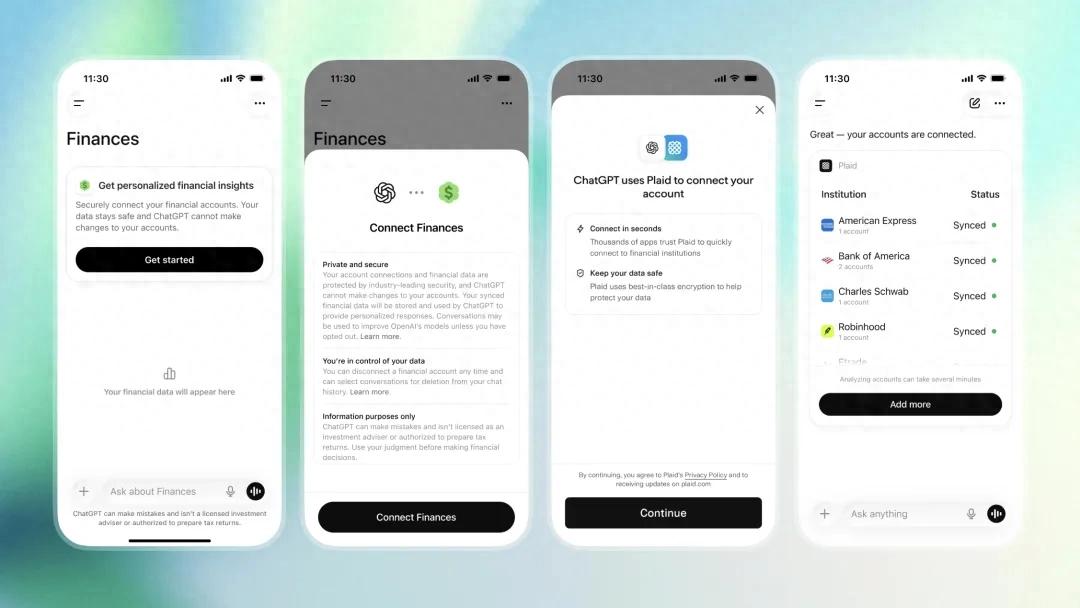
Connect your bank account through Plaid before use | Image Source: OpenAI
Once connected, ChatGPT will take a few minutes to sync and categorize your financial data, then generate a comprehensive visual financial dashboard. This dashboard includes information such as checking and savings account balances, transaction history, categorized spending details, monthly recurring subscription services, upcoming bills, salary deposits, investment performance, and information on credit card debts and mortgages.
However, the dashboard is just the starting point. The truly interesting part is the ‘conversational finance.’ Unlike traditional budgeting tools like Mint or YNAB, ChatGPT does not require you to look at charts, flip through categories, or manually set budgets. You simply ask questions in natural language, and it can provide answers based on your real data.
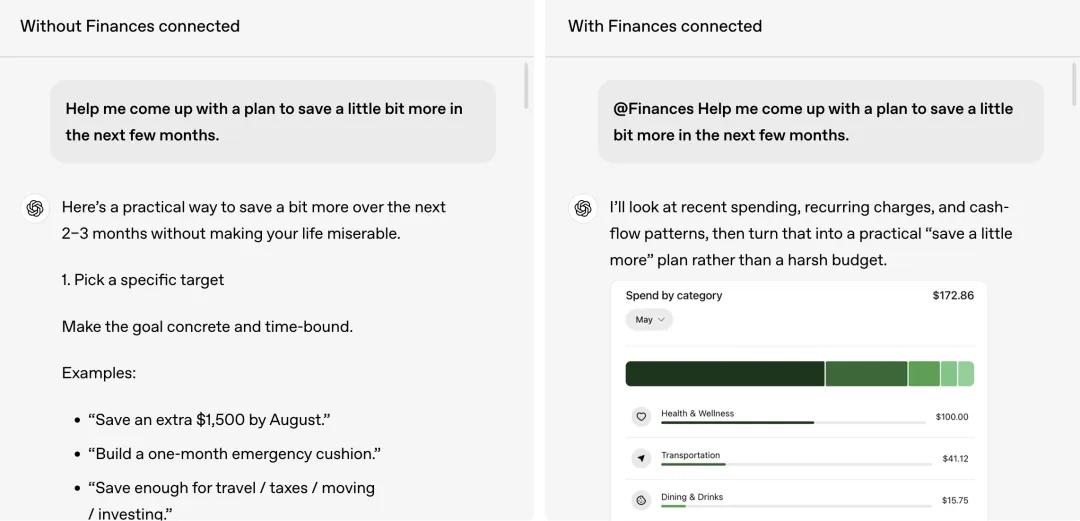
Comparison of financial questions before (left) and after (right) using personal finance data, showing a more planned and targeted approach | Image Source: OpenAI
OpenAI provided several example scenarios: you can ask, “Am I spending more than before? What has changed?” ChatGPT will analyze your transaction records to identify spending trends.
You can say, “Help me create a plan to buy a house locally within five years,” and it will consider your income, savings rate, and current debts to calculate. You can even tell it, “I owe my parents some money” or “I plan to buy a car early next year,” and ChatGPT will store this information in its “financial memory,” considering these contexts in future conversations.
This experience is completely different from asking ChatGPT general financial questions in the past. Previously, if you asked, “How should I save money to buy a house?” you would receive a bunch of generic financial advice. Now, it can see your bank account balance, monthly spending structure, investment returns, and debt ratio, providing tailored solutions instead of vague suggestions like “I recommend saving 20% of your salary each month.”
OpenAI also revealed future plans: it will soon support data integration from Intuit, allowing users to have ChatGPT analyze the tax implications of selling a certain stock or assess the approval probability for a credit card application.
OpenAI aims to transform ChatGPT from a tool that helps you look up concepts into one that assists you in making decisions.
Two Acquisitions, Three Strategic Moves
OpenAI’s move is not a spur-of-the-moment decision.
Its strategy has been in the works for over six months. In October 2025, OpenAI acquired the personal finance app Roi, whose founder Sujith Vishwajith subsequently joined OpenAI.
In April 2026, OpenAI acquired another personal finance startup, Hiro Finance, with founder Ethan Bloch and the entire team integrated into OpenAI. Hiro was positioned as an “AI personal CFO,” having helped users manage over $1 billion in assets. Bloch previously founded the automated savings app Digit, which was acquired for over $200 million in 2021.
Two acquisitions, two fintech veterans, and six months—OpenAI is clearly assembling a ‘financial strike team’ with purpose.
The data driving all this is also impressive. OpenAI disclosed that over 200 million users ask financial-related questions on ChatGPT each month—ranging from budget management to how to cut expenses. These users were already using a “general chatbot” for financial tasks, but previously, ChatGPT’s responses lacked personalized data support.
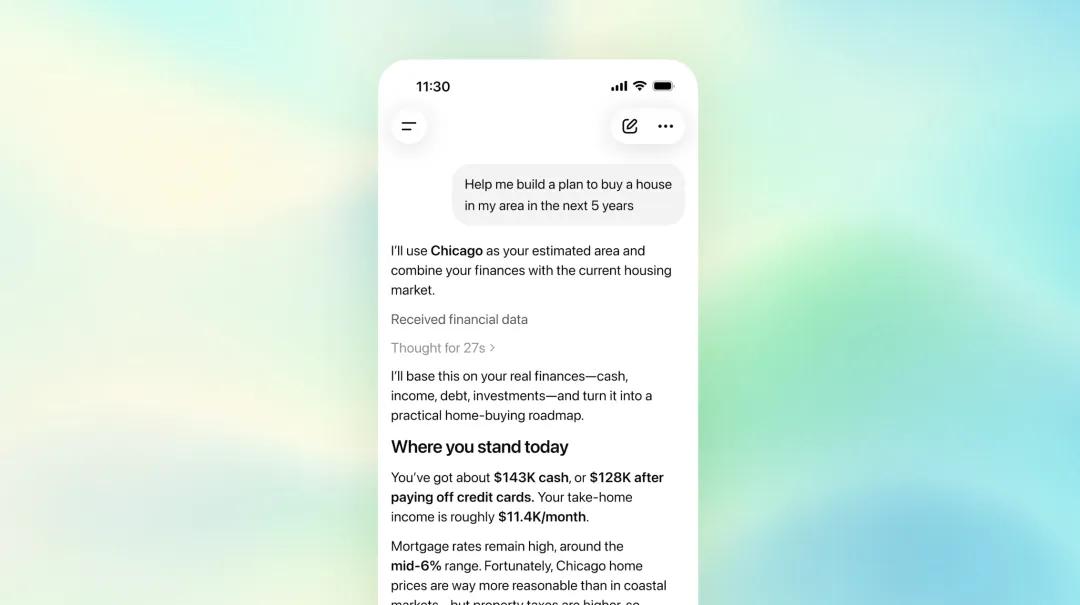
Users can directly conduct financial analysis within ChatGPT | Image Source: OpenAI
Now, with Plaid’s account connection and the enhanced reasoning capabilities of the GPT-5.5 model, ChatGPT’s goal is clear: to evolve from a “jack-of-all-trades” assistant into a true “super assistant” that understands your financial situation.
OpenAI has already traversed this path once.
In January, it launched ChatGPT Health, allowing users to connect medical records and health apps like Apple Health and MyFitnessPal. Official data shows that over 230 million users ask health-related questions on ChatGPT each week. From health to finance, OpenAI is shaping ChatGPT into a gateway for all high-value decision-making scenarios in life.
Privacy Storm Hits Faster Than the Product
However, the issue is that finance is not like writing copy. What you hand over is not just a prompt, but your entire financial profile.
Following the launch of this feature, social media reactions were overwhelmingly skeptical. Some commented on Twitter: “What normal person would be willing to give this level of access to OpenAI?” Others dug up past controversies: “You just got collectively sued for secretly sharing ChatGPT conversation data with Google and Facebook.”
This is not unfounded. Just a day before the launch of this finance feature, a new class-action lawsuit was filed in California federal court, accusing OpenAI of embedding Meta Pixel and Google Analytics tracking codes in the ChatGPT web interface, transmitting chat topics, user IDs, email addresses, and more to Meta and Google for targeted advertising without users’ knowledge. The lawsuit pointed out that many users discuss highly private topics like finance, health, and law on ChatGPT.
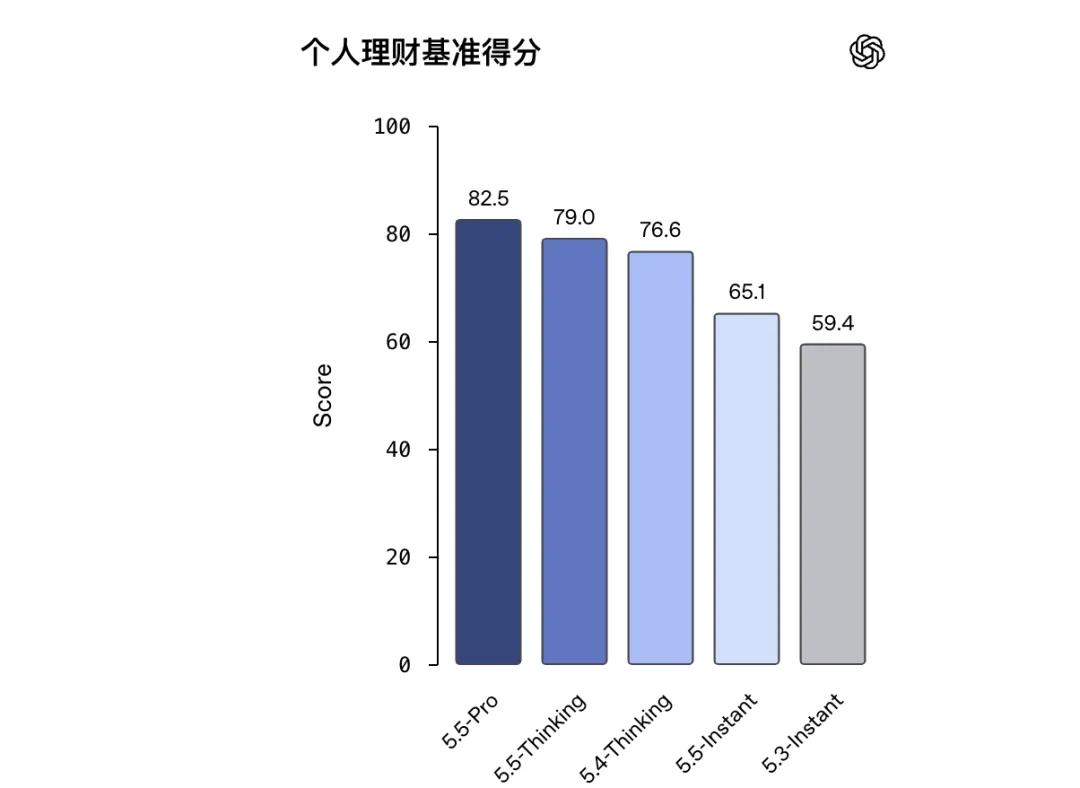
OpenAI officially states that GPT-5.5 Pro performs better for private financial analysis | Image Source: OpenAI
Launching a product that requires users to connect their bank accounts while being sued for secretly sharing user conversation data—this timing is almost a PR disaster.
OpenAI clearly recognizes the trust issue. In its announcement, it repeatedly emphasized that ChatGPT cannot perform any operations on user accounts and cannot see complete account numbers, only reading balances, transaction records, investment portfolios, and debt information. After disconnecting, data will be deleted within 30 days. Users can also view and delete the financial “memory” that ChatGPT retains.
However, one detail is worth noting—there is an optional switch in the system called “Improve the model for everyone.” If users enable this, their financial conversation data will be used to train the AI model. Although this switch is off by default, its existence sends a signal:
Your financial data could theoretically be used as training material within OpenAI’s ecosystem.
AI Companies Rush Towards ‘High-Value Data’
The launch of ChatGPT as a finance tool, when viewed in a broader context, signifies a collective shift in the AI industry.
The era of general chatbots is ending, and the war for ‘vertical super assistants’ has begun.
OpenAI launched health features in January and finance features in May; Anthropic released ten specialized AI agents for the financial industry in early May, directly targeting banking, insurance, and asset management sectors, with data sources including Moody’s, S&P Capital IQ, and Morningstar. Following this news, FactSet’s stock price dropped by 8% that day. Perplexity also launched “Computer for Professional Finance” around the same time, aimed at professional research teams, supporting data integration from PitchBook, Daloopa, and providing 35 preset financial workflows.
Interestingly, Perplexity’s financial product has recently begun supporting users to connect brokerage accounts through Plaid—the same infrastructure used by ChatGPT. This means Plaid is becoming the underlying pipeline for the ‘AI finance’ era, much like Stripe for online payments.
However, the paths of different companies are clearly distinct. OpenAI is pursuing a consumer-facing route, aiming to bring every ordinary person’s bank account into ChatGPT; Anthropic and Perplexity are targeting the B2B route, aiming to replace parts of Bloomberg Terminal’s functionality for financial professionals.
Regardless of whether it’s B2B or B2C, the core logic remains the same: whoever can obtain the most private, high-value data from users will dominate the next stage of AI.
Health data, financial data, legal data—these areas are being targeted by AI companies not because AI suddenly became adept at finance, but because these scenarios inherently require personalization, have high-frequency interactions, and a natural willingness to pay.
The Ultimate Test for ‘Super Assistants’
Returning to the launch of ChatGPT, from a product logic perspective, it has performed well: the connection through Plaid ensures a baseline of security, reading permissions rather than operational permissions reduces risk, and the 30-day data deletion provides an exit mechanism. OpenAI also stated it will soon support Intuit connections, allowing users to analyze the tax implications of stock sales and assess credit card application approval probabilities.
However, there is a chasm between a well-executed product and user trust.
Sam Altman aims to transform ChatGPT into a “personal super assistant” that covers all aspects of life—from writing to searching, health to finance, programming to shopping. This vision is undeniably grand. But the more ambitious the vision, the higher the trust requirements. OpenAI’s record on privacy issues does not inspire complete confidence.
A comment on Slashdot put it bluntly: “Handing over your bank account to a chatbot that can hallucinate? When will AI-generated financial advice come with a disclaimer?”
While this statement is sharp, it indeed touches on a core issue. AI finance tools fundamentally differ from traditional financial advisors—human advisors are subject to financial regulations, have licenses, and legal responsibilities; whereas ChatGPT’s terms of service clearly state it does not provide investment advice and assumes no financial consequences.
When a tool appears to act like a financial advisor, speaks like one, and even understands your spending data better than most advisors—but legally, it is nothing—this presents a gray area that needs serious discussion.
OpenAI stated it will first collect feedback from Pro users before deciding whether to open it to Plus users. This is a smart strategy—using the most eager early adopters to “test and learn.” But if the trust issue is not resolved, a larger user base may never come.
ChatGPT is technically ready to manage your money.
But are you ready? This may be a question everyone will face in the AI era.
Comments
Discussion is powered by Giscus (GitHub Discussions). Add
repo,repoID,category, andcategoryIDunder[params.comments.giscus]inhugo.tomlusing the values from the Giscus setup tool.